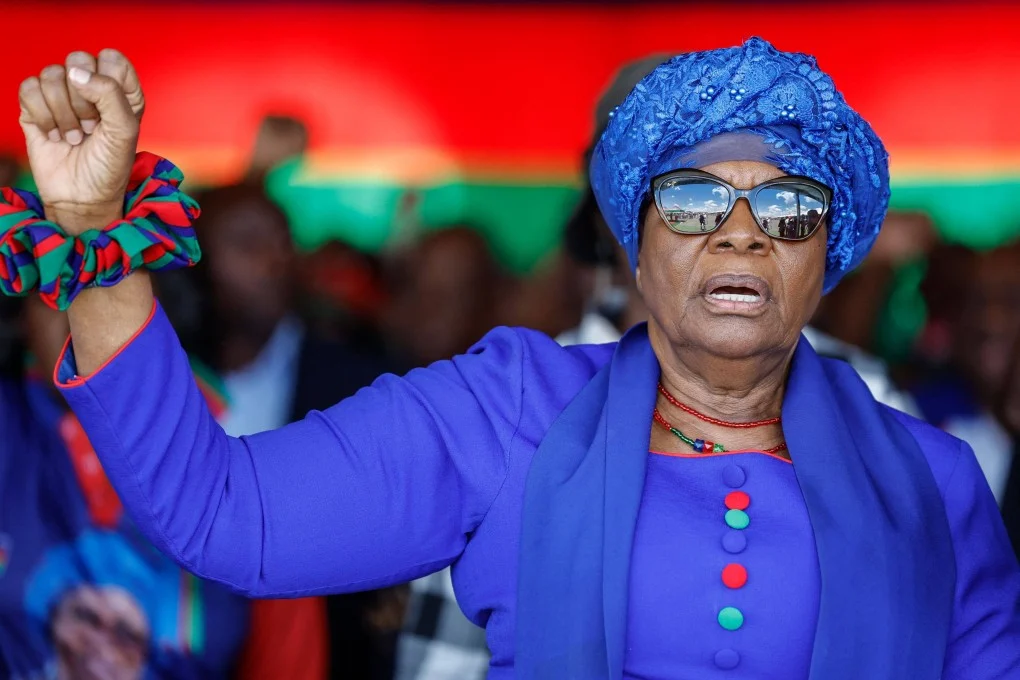
WINDHOEK, Namibia — Netumbo Nandi-Ndaitwah was sworn in Friday as Namibia’s first female president, making history in a country grappling with economic inequalities, high unemployment and poverty.
Nandi-Ndaitwah, 72, won November’s election with 58% of the vote, becoming not only Namibia’s first female head of state but also Africa’s second-ever directly elected female president.
She succeeds President Nangolo Mbumba, who held office following the death of former President Hage Geingob in early 2024.
“If things go well then it will be seen as a good example,” Nandi-Ndaitwah said in an interview with the BBC’s Africa Daily podcast. “But if anything then happens, like it can happen in any administration under men, there are also those who would rather say: ‘Look at women!’”
A longtime member of the ruling South West Africa People’s Organisation, or Swapo, Nandi-Ndaitwah joined the party at age 14 when it was still a liberation movement fighting South Africa’s apartheid regime.
Swapo has governed Namibia since the country gained independence in 1990.
While Namibia has made significant progress since the end of white-minority rule, the economic legacy of apartheid remains entrenched.
Land ownership, in particular, continues to reflect racial disparities. Government statistics show that white farmers—who represent less than 2% of the population—own about 70% of the country’s farmland.
“Truly, land is a serious problem in this country,” Nandi-Ndaitwah said. “We still have some white citizens and more particularly the absent land owners who are occupying the land.” She reaffirmed her support for the “willing-buyer, willing-seller” model of land reform.
With a population of about 3 million spread across vast territory, Namibia has one of the highest levels of income inequality in the world.
The World Bank recorded a Gini coefficient of 59.1 in 2015. Poverty remains stubbornly high, with a projected rate of 17.2% in 2024. Unemployment rose to 36.9% in 2023, up from 33.4% in 2018.
Nandi-Ndaitwah said her administration will prioritize economic diversification, focusing on adding value to mineral exports instead of shipping raw materials abroad.
She also emphasized investment in the creative economy and reforms in education to align with shifting job markets.
Despite the symbolic weight of her presidency, Nandi-Ndaitwah said she wants to be judged on her leadership—not her gender. “It’s a good thing that we as countries are realizing that just as men [can do], women can also hold the position of authority,” Nandi-Ndaitwah said.
She joins Tanzania’s Samia Suluhu Hassan as one of two current female presidents on the continent. Hassan assumed office in 2021 following the death of President John Magufuli. Liberia’s Ellen Johnson Sirleaf, who served from 2006 to 2018, was Africa’s first woman elected president.