 Women and girls considered to have made great gains – demolishing barriers, dismantling stereotypes and driving progress towards a more just and equal world. Yet they face various obstacles in their quest. Billions of women and girls face marginalization, injustice and discrimination, while the persistent epidemic of violence against women disgraces humanity according to the United Nations.
As such, the Boresah Royal Foundation has called on governments to empower women to participate in politics, science, economic and other facets of national development.
According to Executive Director of the foundation, Queen Boresah Fantevie when women and other minority groups are empowered it promotes innovation and creativity necessary for national development.
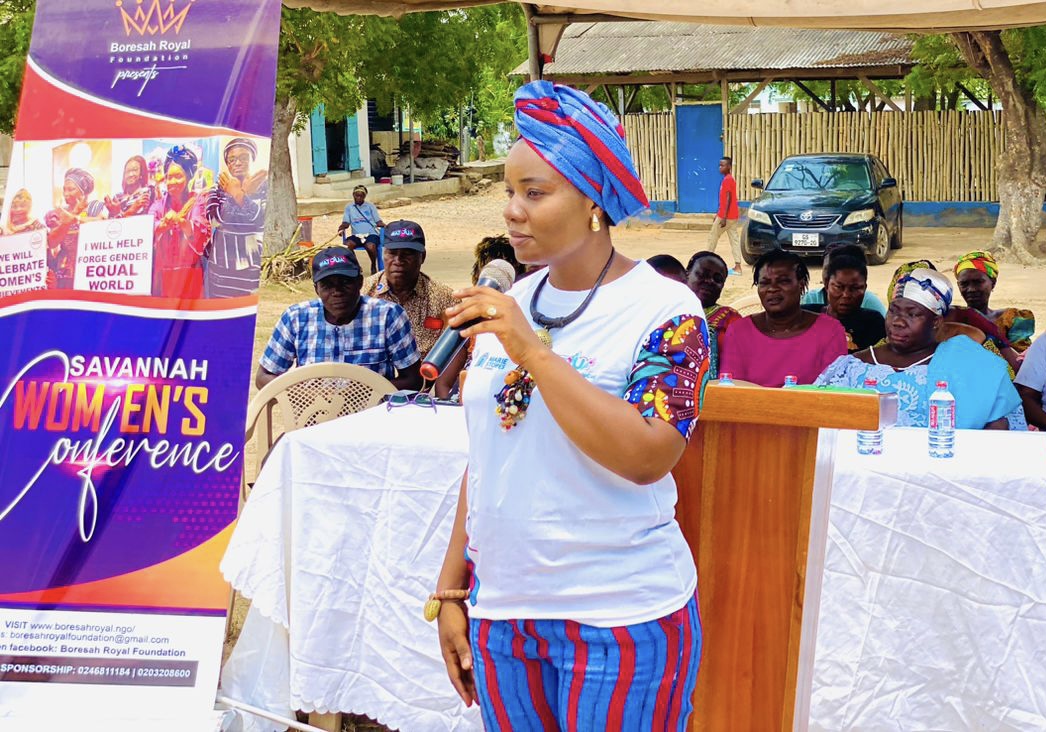
“Affirmative action policies will help to promote diversity and inclusivity, which are essential for promoting innovation and creativity. When teams are composed of individuals from diverse backgrounds and perspectives, they are better equipped to handle complex problems and develop creative solutions.
“The passage of Affirmative action policies will not take away the glory of men as others may be thinking but will only help to ensure that these benefits are distributed more equitably across society by expanding access to education and employment opportunities”, Queen Boresah said.
She said this on the back of the commemoration of International Women’s Day and a Women’s Conference held at Saduase, a community in the Kpone Katamanso Municipality as part of the 3rd edition of the Savannah Women’s Conference in Accra on March 8, 2024.
While highlighting the theme for this year’s International Women’s Day celebration, “Invest in Women: Accelerate Progress”, she underscored the need for stakeholders to target and fight economic disempowerment.
“To promote women empowerment, we must invest in programmes and initiatives that will contribute to end violence and stigmatization against women, and drive women’s inclusion in leadership roles, peace-building and climate action. I implore stakeholders to be deliberate on Women’s rights promotion because this proves as a path to fair, peaceful and prosperous societies”, she said.

Key stakeholders who graced the event included Queen and elders of the Sadause community, Naa Dede Obrempong, Marie Stopes International was represented by madam Eunice Kufoalor and the District Director of the Department of Social Welfare, Madam Theresah Kutu.
Others speakers includes Mrs Felicia Yeboah Dafeamekpor, an educationist ,Madam Gertrude Awauh Peasah, a retired public health nurse and Dr.Patience Akude, a retired Chief Medical Officer of the Shai Osudoku District Hospital.
The event saw the showcase of talent from students of the Sasaabi and the Saduase KKMA schools through wonderful performances.
Ghana’s Affirmative Action Bill:
The Affirmative Action (Gender Equality) Bill, 2023 was laid in Parliament in October 2023, though the bill has been in the works since 2011. The bill, when passed into law, will address the apparent marginalization of women in key decision-making spaces in Ghana by ensuring a representation of at least 30% of women in public life.
Over the years, Ghana has been grappling with low representation of women and other marginalized groups. The number of women in leadership positions at both local and national levels is discouraging as the country has failed to achieve the 30% UN target for women’s participation.
Article 17 clause 4 of the 1992 constitution of Ghana further provides that nothing prevents Parliament from enacting a law when there is clear historical evidence of gender discrimination.
This, however, is the basis for calls from stakeholders to the government to ensure the passage of the Affirmative Action Bill to bridge the gender disparity in the country aimed at accelerating progress through inclusion and active participation of women in key-decision decision-making spaces.