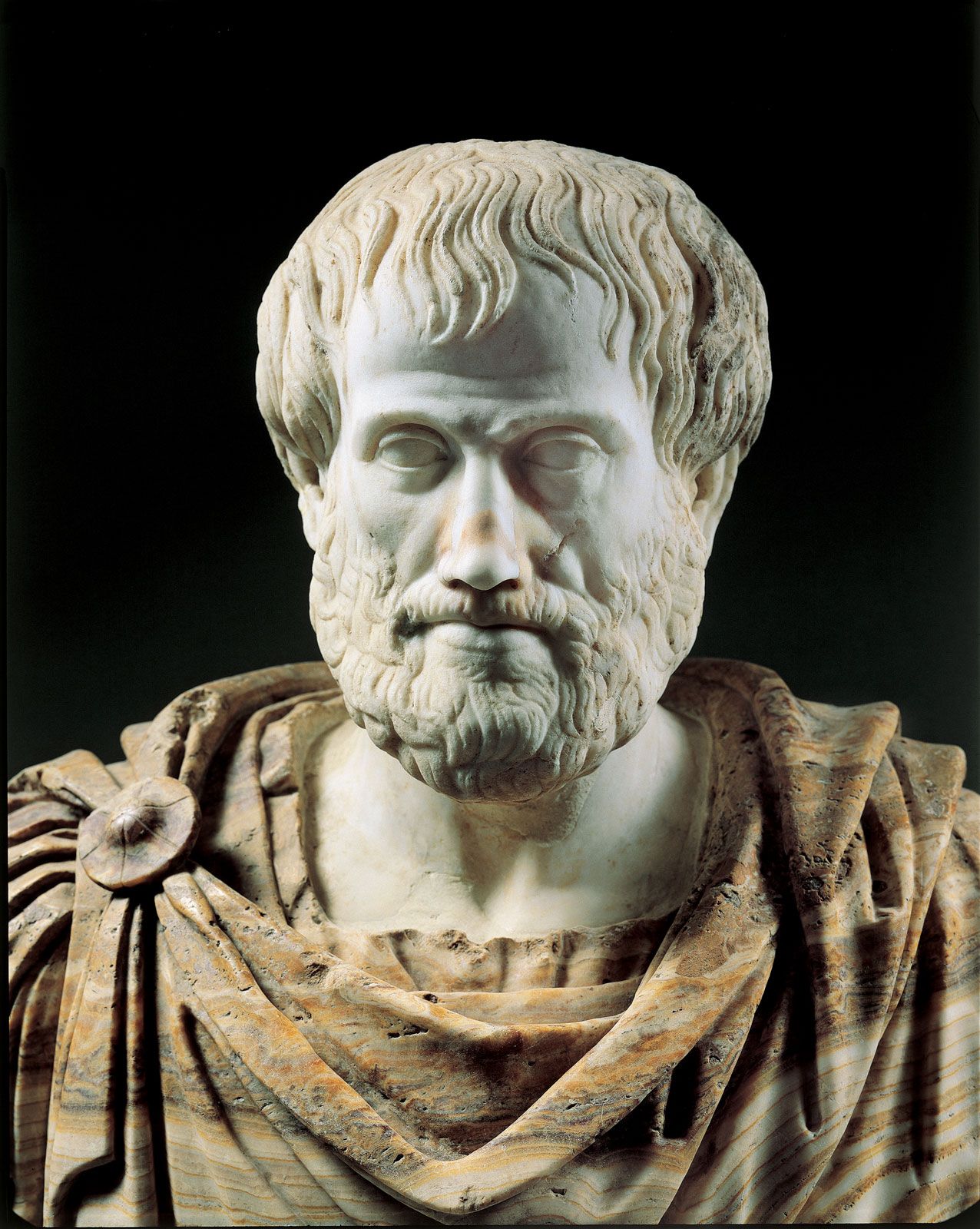
Aristotle, an ancient Greek scientist, and philosopher is considered one of the greatest intellectual figures of Western history. It’s most likely that he was born in 384 BC in an Ancient Greek city, Stagira. The town is located about 34 miles from the modern-day Greek town, Thessaloniki. He died when he was 63 years old of natural causes.
Aristotle was interested in almost every field of human knowledge, and he wasn’t afraid to step foot even into those topics that no one studied before him. Due to his open-minded way of thinking, he was exploring most of the sciences, including botany, biology, zoology, physics, chemistry, and metaphysics. He was also very invested in reading and writing about ethics, logic, rhetoric, philosophy of mind, philosophy of science. political theory, psychology, history, poetics, and political theory.

Aristotle is known as the author of a scientific and philosophical system that later became the groundwork and vehicle for Christian Scholasticism, as well as medieval Islamic philosophy. Since Aristotle’s time, the world has seen many intellectual revolutions, including the Renaissance, the Reformation, and the Enlightenment. However, Aristotelian concepts survived the test of the time and remained planted deep in the roots of Western thinking. (1)
It goes without saying that Aristotle was a remarkable person, whose principles were well ahead of his time. With that in mind, we prepared a list of interesting facts about his life for you. Without any further ado, let’s find out more about this exceptional person and dive into these Aristotle facts!
1.Aristotle was Plato’s student
It’s no secret that Aristotle was one of Plato’s most prominent students. At the age of 17, Aristotle’s guardian at the time, Proxenus, sent him to Athens for a chance to get a higher education. That’s when Aristotle enrolled in Plato’s Academy. It didn’t take long after he was recognized as an extraordinary student. The two men built a very close relationship over the years, and it was believed that Aristotle would become the principal of the Academy.
Plato died in 347 BCE, but Aristotle didn’t go on to become the head of the Academy. The reason for this is that Aristotle disagreed with some of Plato’s philosophical thesis. (2)
2. Aristotle tutored Alexander the Great
More than 10 years after he left his home to pursue higher education, Aristotle went back home to Macedonia. He quickly landed a job, and his employer was no one less than King Phillip II. Aristotle went on to tutor the king’s son, a 13-year old boy, who would grow up to become Alexander the Great, one of the most known leaders of his time.
Aristotle was Alexander’s tutor for 7 years until Alexander ascended to the throne in 336 BCE. Aristotle’s teachings had a great influence on Alexander, which can be seen in his handling of challenging political problems throughout his ruling. (3)
3. Aristotle opened a school in Athens
Only one year after Alexander the Great became the king, he conquered Athens, and that’s when Aristotle decided to go back to the city where he studied. At this time, Plato’s Academy was still one of the premier educational institutions in Athens. Aristotle wanted to educate, but he had no intention to do so under the roof of Plato’s Academy.
He asked for approval from Alexander and opened his own institution, Lyceum. From that moment forward, he dedicated most of his time to teaching his students, doing research, and writing about his findings.
While Plato’s Academy was dedicated to closed circles of intellectuals, Lyceum was open to the public and lectures were free of charge. The school was also home to one of the largest collections of manuscripts at the time. Because of that, it’s believed that Lyceum had one of the first great libraries in the entire world. (4)
4. Aristotle studied animals
Even though Aristotle’s work is well known throughout the entire world, there are some things that are overshadowed by his philosophical work. One of the less known facts about Aristotle is that he was very interested in zoology, and he carefully observed animals. He was the first to classify animals into two separate groups, which he named red-blooded-animals, and not-red-blooded-animals. Today, these groups are called vertebrates and invertebrates.
He was also mesmerized by marine biology, and he spent some time on the Lesbos island in Greece doing research. His research was directed towards observing marine animals and dissecting them to study their anatomy. The findings he made about these animals were surprisingly accurate.
It’s believed that Aristotle was the first human in history to study animals in such a way. He also studied plants, but this part of his work was lost, and we can’t know for sure whether he was invested in researching plants as he was into animals, and how accurate his observations were. (5)
5. He created more than 200 works
Even though it’s believed that Aristotle created more than 200 different works on many diverse topics, only 31 have survived until today. His writings about animals, the Physics, and cosmology deal with the quasi-theological investigation of life and existence. Aristotle was also very passionate about the topics that deal with the nature of human flourishing on the individual, societal and familial levels. Some of his most popular works, Rhetoric and Poetics deal with the finished products of human productivity. (6)
6. Aristotle was sometimes wrong
Anyone who succeeded at anything knows that mistakes are part of the learning curve. Even though Aristotle’s studies were well ahead of his time, he was also a human being that sometimes made mistakes. For example, he thought that the heart was the center of intelligence, not the brain. (7) Aristotle also claimed women have less teeth than men, that men have hotter blood than women, and that in general, men are superior to women. (8)
7. He had two children
Aristotle’s first wife was Pythias, the daughter of his friend, Hermias of Atarneus. The two met while Aristotle was staying in the Greek island Lesbos, which he visited in order to research botany and zoology of the island and the sheltered lagoon. Pythias and Aristotle had one daughter, who was also named Pythias. (9)
After his first wife’s death, Aristotle was involved with another woman, Herpyllis of Stagira. The two of them had a child, a son named after his father, Nicomachus. (10) There’s not much information available today about his children, but it’s believed both of them died before their father. Nicomachus died 3 years before Aristotle in a battle, when he was young. It’s widely believed that one of Aristotle’s works, Nicomachean Ethics, is dedicated to his son. However, the work doesn’t state that clearly and it might have been dedicated to Aristotle’s father, too. (11)
8.Most of his published works are lost
Most of Aristotle’s surviving works, including On the Soul, Poetics, and Nicomachean Ethics, were never meant to be published. These fragments of his work were created as studying material for his students, and probably don’t represent the best of his work. Most of his work that was intended for publication has, unfortunately, been lost over time. (6)
9. He was the first person to mention Antarctica in his work
Centuries before Antarctica was discovered, Aristotle was the first person in history to mention Antarctica! In the book Meteorology, Aristotle shared an idea of a landform that exists in the southern high-latitude region of planet Earth. Even though he made some mistakes in his work, this one was actually spot on! In his honor to that, a mountain range in Antarctica is named after him. (12)
10. Aristotle made first observations of natural events
As you’ve already learned from this list of facts about Aristotle, he was a pioneer in many fields, and Geology is no different! He was one of the first people to methodically study geology. He described some of the natural events he observed as “deserts that had become watered by rivers” or “lakes that had dried up”.
He was also among the first ones who advocated the theory that Earth’s changes are too slow to see them all happen in a single human lifetime. (13)
11. After Alexander the Great died, he had to leave Athens
Alexander’s death caused anti-Macedonian currents to form among Athenians. Soon enough, Aristotle was seen as the enemy, due to his Macedonian roots and connections. He decided to leave Athens before things got ugly. He moved to Euboea, where his mother had estates. On one occasion, Aristotle stated: “I will not allow the Athenians to sin twice against philosophy”, which was a reference to the execution of Socrates. Later that year, Aristotle died of natural causes at age 63. His last wish was to be buried next to his wife, Pythias. (14) (15)
Just one look at these facts about Aristotle shows us how diverse his knowledge and interests were. He had a strong intellectual and artistic curiosity, which allowed him to excel in nearly every aspect of human knowledge and leave a remarkable legacy behind him.
What are your favorite facts about Aristotle? Let us know in the comments section below!
40 Excellent Quotes by Aristotle on Life, Education & Politics
It is the mark of an educated man to look for precision in each class of things just so far as the nature of the subject admits.”
– Quotes by ARISTOTLE, Nicomachean Ethics – Book I
“The life of money-making is one undertaken under compulsion, and wealth is evidently not the good we are seeking; for it is merely useful and for the sake of something else.”
– QUOTES BY ARISTOTLE, NICOMACHEAN ETHICS – BOOK I
“For one swallow does not make a summer, nor does one day; and so too one day, or a short time, does not make a man blessed and happy.”
– ARISTOTLE, NICOMACHEAN ETHICS – BOOK I
“Let this serve as an outline of the good; for we must presumably first sketch it roughly, and then later fill in the details.”
– ARISTOTLE, NICOMACHEAN ETHICS – BOOK I
“Everything that depends on the action of nature is by nature as good as it can be.”
– ARISTOTLE, NICOMACHEAN ETHICS – BOOK I
“The truly good and wise man will bear all kinds of fortune in a seemly way, and will always act in the noblest manner that the circumstances allow.”
– ARISTOTLE, NICOMACHEAN ETHICS – BOOK I
“For the things we have to learn before we can do, we learn by doing.”
– QUOTES BY ARISTOTLE, NICOMACHEAN ETHICS – BOOK I

“In a word, acts of any kind produce habits or characters of the same kind.”
– QUOTES BY ARISTOTLE, NICOMACHEAN ETHICS – BOOK II
“Anybody can become angry, that is easy; but to be angry with the right person, and to the right degree, and at the right time, for the right purpose, and in the right way, that is not within everybody’s power and is not easy.”
– ARISTOTLE, NICOMACHEAN ETHICS – BOOK II (Variant)
“We must as second best, as people say, take the least of the evils.”
– ARISTOTLE, NICOMACHEAN ETHICS – BOOK II
“Therefore only an utterly senseless person can fail to know that our characters are the result of our conduct.”
– ARISTOTLE, NICOMACHEAN ETHICS – BOOK III
“Without friends no one would choose to live, though he had all other goods.”
– ARISTOTLE, NICOMACHEAN ETHICS – BOOK VIII
“The best friend is he that, when he wishes a person’s good, wishes it for that person’s own sake.”
– ARISTOTLE, NICOMACHEAN ETHICS – BOOK ix
“And happiness is thought to depend on leisure; for we are busy that we may have leisure, and make war that we may live in peace.”
– QUOTES BY ARISTOTLE, NICOMACHEAN ETHICS – BOOK X

Quotes by Aristotle on Life
“Knowing yourself is the beginning of all wisdom.”
ARISTOTLE
“It is the mark of an educated mind to be able to entertain a thought without accepting it.”
ARISTOTLE
“Happiness is the meaning and the purpose of life, the whole aim and end of human existence.”
ARISTOTLE
“Those who know, do. Those that understand, teach.”
ARISTOTLE
“Poverty is the parent of revolution and crime.”
ARISTOTLE
Quotes by Aristotle From ‘Politics’
“Man is by nature a political animal.”
– QUOTES BY ARISTOTLE, Politics – Book I
“Nature does nothing uselessly.”
– ARISTOTLE, POLITICS – BOOK I
“Where some people are very wealthy and others have nothing, the result will be either extreme democracy or absolute oligarchy, or despotism will come from either of those excesses.”
– ARISTOTLE, POLITICS – BOOK I
“He who is unable to live in society, or who has no need because he is sufficient for himself, must be either a beast or a god.”
– ARISTOTLE, POLITICS – BOOK I

“Man, when perfected, is the best of animals, but when separated from law and justice, he is the worst of all.”
– QUOTES BY ARISTOTLE, – BOOK I
“Money was intended to be used in exchange, but not to increase at interest. And this term interest, which means the birth of money from money, is applied to the breeding of money because the offspring resembles the parent. Wherefore of all modes of getting wealth this is the most unnatural.”
– ARISTOTLE, POLITICS – BOOK I
“It is of the nature of desire not to be satisfied, and most men live only for the gratification of it.”
– ARISTOTLE, POLITICS – BOOK II
“Even when laws have been written down, they ought not always to remain unaltered.”
– ARISTOTLE, POLITICS – BOOK II
“That judges of important causes should hold office for life is a disputable thing, for the mind grows old as well as the body.”
– ARISTOTLE, POLITICS – BOOK II

“The good citizen need not of necessity possess the virtue which makes a good man.”
– QUOTES BY ARISTOTLE, POLITICS – BOOK III
“The law is reason unaffected by desire.”
– ARISTOTLE, POLITICS – BOOK III
“Inferiors revolt in order that they may be equal, and equals that they may be superior. Such is the state of mind which creates revolutions.”
– ARISTOTLE, POLITICS – BOOK V
“The basis of a democratic state is liberty.”
– ARISTOTLE, POLITICS – BOOK Vi
“The appropriate age for marriage is around eighteen for girls and thirty-seven for men.” (We wonder if this one was supposed to be humorous!)
– ARISTOTLE, POLITICS – BOOK VII
“Happiness, whether consisting in pleasure or virtue, or both, is more often found with those who are highly cultivated in their minds and in their character, and have only a moderate share of external goods, than among those who possess external goods to a useless extent but are deficient in higher qualities.”
– ARISTOTLE, POLITICS – BOOK VIi
“Those who cannot face danger like men are the slaves of any invader.”
– ARISTOTLE, POLITICS – BOOK VII

Quotes by Aristotle From Various Works
“Knowledge of the fact differs from knowledge of the reason for the fact.”
– Aristotle, Posterior Analytics – Part XIII
“All men by nature desire to know.”
– ARISTOTLE, Metaphysics – Book I
“It is simplicity that makes the uneducated more effective than the educated when addressing popular audiences.”
– ARISTOTLE, Rhetoric – Book II
“Poetry demands a man with a special gift for it, or else one with a touch of madness in him.”
– ARISTOTLE, Poetics
“The roots of education … are bitter, but the fruit is sweet.”
– QUOTES BY ARISTOTLE, The lives and Opinion of Eminent Philosophers

Follow @Thrillernewsgh for more educative content.
–
Source: Turtlequotes.com