
Ghana’s flagship ‘No Academic Fee Policy’ for first-year tertiary students has attracted more than 129,000 applicants through the government’s No-Fees-Stress portal.
The Minister of Education Haruna Iddrisu, announced Wednesday during a quarterly briefing on the education sector.
Iddrisu revealed that 129,054 applications were received as of June 17. So far, 107,429 students have completed the process, and 22,592 have been validated for disbursement.
“Out of 168 public tertiary institutions, 114 had submitted their enrollment data to facilitate implementation of the policy,” Iddrisu said.
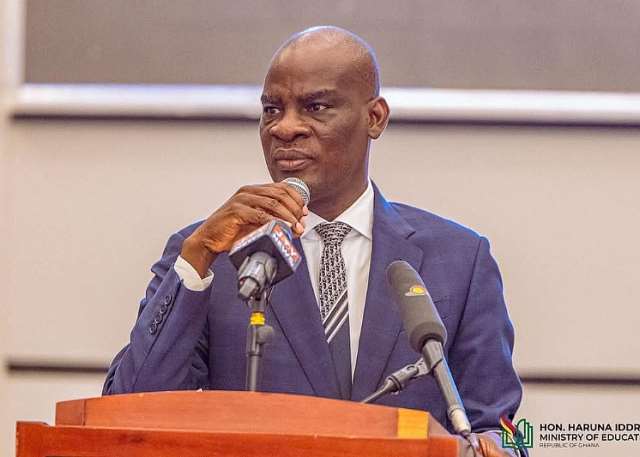
The minister also outlined key education reforms discussed at the National Consultative Review Forum on Education held in February.
The forum received over 5,000 memoranda and included a nationwide survey of 20,000 respondents on the Free SHS Policy.
Among the key changes, the government plans to shift school placement strategies by expanding day-schooling in urban centers while improving boarding facilities in rural and underserved areas to address access disparities.
“This approach aligns with our commitment to equitable education opportunities for all Ghanaian children, regardless of their location,” Iddrisu said.
Technical and Vocational Education and Training (TVET) is also being repositioned from a “last resort” option to a premium alternative pathway.
“A Cabinet paper is being finalized to introduce a new TVET Fund to support apprenticeships and provide toolkits to trainees,” Iddrisu said.
The minister praised the rollout of a GH₵290 million sanitary pad initiative, in partnership with the Ministry of Gender and Social Protection.
He said early results show reduced absenteeism among female students, addressing what he called a “critical but often overlooked barrier” to girls’ education.
On basic education, Iddrisu said over 603,000 candidates participated in the recent Basic Education Certificate Examination (BECE), which was generally well conducted. However, he noted isolated cases of misconduct by invigilators.
According to minister, monitoring teams from the Ghana Education Service had visited examination centers to ensure compliance.
To guide upcoming changes, an Education Reform Implementation Committee will soon be established.
A cabinet memorandum is also in development to address infrastructure, sustainable financing, and quality enhancement.
“The President has guaranteed full respect for institutional autonomy,” Mr. Iddrisu said. “Nearly all boards of public tertiary institutions have now been inaugurated. Four recently upgraded technical universities are awaiting formal governance structures, which would be addressed through new legislation in Parliament.”
The minister also addressed longstanding concerns about promotions within the Ghana Education Service (GES), saying the President had directed the immediate elevation of qualified teachers stuck in deputy director positions for more than a decade.
“Promotions will now be based on merit and tenure, not merely vacancy availability,” Iddrisu said.
On recent controversies surrounding teacher recruitment, Iddrisu clarified that some appointments lacked financial clearance and others were under audit.
“Once cleared, affected teachers will receive their appointment letters and salaries,” Iddrisu said.
He also issued a warning against fraudulent recruitment practices and pledged investigations into unauthorized payroll entries.